
2026 NEC Arc Flash Label Requirements: What Electrical Contractors Need to Know
Arc flash labeling requirements changed significantly with the 2026 edition of the National Electrical Code (NEC). For electrical contractors working on commercial, industrial and other non-dwelling projects, one of the biggest changes is found in NEC 110.16, Arc Flash Hazard Marking.
The 2026 NEC expands which service and feeder supplied equipment requires permanent arc flash marking and establishes specific information that must be included. The revised requirements also bring the NEC more closely in line with the arc flash equipment labeling practices established by NFPA 70E.
For contractors, engineers and facility teams, that makes understanding the distinction between arc flash hazard labels and permanent equipment identification increasingly important.
What Changed with Arc Flash Labels in the 2026 NEC
The biggest change is the removal of the previous 1,000-amp threshold.
Under the 2023 NEC, Section 110.16(B) required a permanent arc flash label on service equipment and feeder supplied equipment rated 1,000 amps or more in locations other than dwelling units.
The 2026 NEC removes that amperage threshold.
NEC 110.16 now requires permanent arc flash marking on applicable service equipment and feeder supplied equipment in locations other than dwelling units when that equipment is likely to require examination, adjustment, servicing or maintenance while energized.
Examples identified by the NEC include:
- Switchboards
- Switchgear
- Enclosed panelboards
- Industrial control panels
- Meter socket enclosures
- Motor control centers
Because the section uses these as examples rather than an exhaustive list, contractors should evaluate other service and feeder supplied equipment that falls within the scope of the requirement.
The practical takeaway: Arc flash marking under the 2026 NEC is no longer limited to service and feeder supplied equipment rated at 1,000 amps or more.
What Information Is Required on a 2026 NEC Arc Flash Label
The 2026 NEC also becomes much more specific about what the arc flash hazard marking must communicate.
Under NEC 110.16, the permanent marking must include:
- Nominal system voltage
- Arc flash boundary
- Available incident energy or the minimum required level of personal protective equipment (PPE)
- The date of the assessment was completed
The marking must also comply with the permanence requirements of NEC 110.21(B), be clearly visible to qualified people and follow applicable industry practice.
This is a significant change from the more general warning label approach found in previous editions of the NEC.
Why Does the Assessment Date Matter
The fourth requirement is particularly important: the date the assessment was completed.
The 2023 NEC required certain arc flash labels to include the date the label was applied. The 2026 NEC instead requires the date of the assessment.
Those dates are not necessarily the same.
An arc flash assessment may be completed before labels are manufactured and installed. Using the assessment date provides information about the age of the electrical data behind the label rather than simply identifying when the physical label was attached to the equipment.
This also connects the NEC requirement more closely with NFPA 70E.
NFPA 70E requires the data supporting arc flash label information to be reviewed for accuracy at intervals not exceeding five years. If changes to the electrical distribution system make the information inaccurate, the label must be updated.
In other words, an arc flash label is not simply a permanent warning sticker. The physical label may be durable, but the site-specific electrical information displayed on it must remain accurate for the system it represents.
NEC 110.16 vs. NFPA 70E 130.5(H): What’s the Difference
The NEC and NFPA 70E address arc flash labeling from different perspectives, but the 2026 NEC brings the two requirements much closer together.
NEC 110.16 establishes arc flash marking requirements as part of the electrical installation.
NFPA 70E 130.5(H) addresses equipment labeling as part of electrical safety in the workplace.
NFPA 70E requires applicable equipment to be labeled with:
- Nominal system voltage
- Arc flash boundary
- Available incident energy and corresponding working distance, or the applicable arc flash PPE category, but not both
- Or the minimum arc rating of clothing
- Or a site-specific level of PPE
NFPA 70E also requires documentation supporting the label information and periodic review of that data.
The 2026 NEC now requires much of the same core hazard information directly on the permanent arc flash marking.
2026 NEC vs. NFPA 70E Arc Flash Label Information
| Label Information | 2026 NEC 110.16 | NFPA 70E 130.5(H) |
| Nominal system voltage | Yes | Yes |
| Arc flash boundary | Yes | Yes |
| Incident energy / PPE information | Yes | Yes, with more specific options |
| Assessment date on marking | Yes | Not specifically required on the label |
| Supporting data/documentation | — | Yes |
| Periodic data review | — | At intervals not exceeding 5 years |
The NEC requirement does not replace the need to understand and apply NFPA 70E. Contractors should work from the project specific arc flash assessment and applicable project requirements when determining the information that belongs on each label.
Who Determines the Information on an Arc Flash Label
A label manufacturer does not determine a facility’s incident energy, arc flash boundary or required PPE.
Those values come from the electrical system assessment performed by the appropriate qualified professional using information about the electrical distribution system.
Depending on the project, an arc flash assessment may consider factors including available fault current, protective device clearing times, equipment configuration and working distance.
Once the assessment has established the required information, that data can be used to produce the physical labels installed on the equipment.
This distinction is important: The electrical assessment determines the hazard. The label communicates it.
Arc Flash Labels vs. Permanent Equipment Identification
Arc flash labels are only one layer of electrical labeling found on a commercial project.
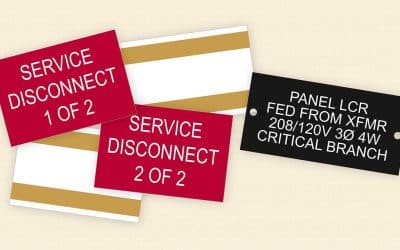
Electrical equipment also requires identification that tells electricians, facility personnel and other qualified workers what the equipment is, what it serves or where its power originates.
For example:
PANEL LP-2
AHU 3 DISCONNECT
FED FROM MDP-1
480Y/277V
These labels serve a different purpose from arc flash hazard labels.
| Arc Flash label | Equipment Identification Label | |
| Primary purpose | Communicates an electrical hazard | Identifies equipment or what it serves |
| Information | System and hazard specific | Equipment/service identification |
| Information may change | Yes, if system conditions change | Typically remains with the equipment unless the system/designation changes |
| Common applications | Switchgear, panelboards, MCCs and other applicable equipment | Panels, disconnects, switchgear, equipment, feeders and controls |
| Applicable requirements | NEC 110.16 / NFPA 70E | Varies by equipment and application |
| Typical production | Durable printed hazard label | Often engraved phenolic, metal or other durable identification |
A project may therefore require both an arc flash hazard label and permanent equipment identification on the same piece of electrical equipment. They should not be treated as interchangeable.
Does the NEC Require Arc Flash Labels to Be Engraved
No. The NEC does not require an arc flash hazard label to be engraved.
NEC 110.16 requires a permanent arc flash marking, and the marking must comply with NEC 110.21(B). Section 110.21(B) addresses field applied hazard markings and requires them to be permanently affixed and sufficiently durable for the environment involved.
The appropriate label construction therefore depends on the application, environment and project specifications.
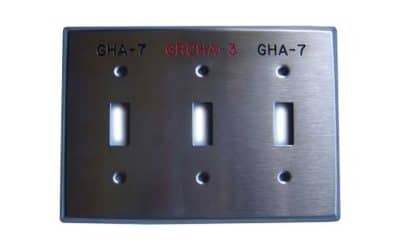
This is different from permanent electrical equipment identification, where engraved phenolic labels, engraved metal tags and other durable identification materials are commonly specified for commercial and industrial electrical projects.
The material should always be selected based on the project’s specifications and the conditions where the identification will be installed.
Planning Arc Flash and Equipment Labels for Large Projects
The physical production of electrical labels becomes another consideration when a project contains hundreds or thousands of pieces of equipment.
Large labeling packages may contain variable information for every panel, disconnect, switchboard or other piece of equipment. Keeping that information structured from the beginning can reduce manual entry and help maintain consistency throughout production.
When sending electrical labeling information to Action Engraving, useful project information can include:
- Final approved label wording or label data
- Label type
- Dimensions
- Material
- Color requirements
- Quantity
- Mounting requirements
- Project specifications
- Panel, equipment or location information
- Required in hand date
- Any required sorting or packaging structure
For large projects, identifying how labels should be organized — by building, floor, room, panel, phase or another project specific system — can also make installation significantly easier in the field.
Producing Electrical Labels at Scale
Action Engraving works with electrical contractors on commercial and mission critical projects that require both individual equipment identification and large, variable data labeling packages.
Depending on the specifications of the project, electrical identification can include engraved phenolic labels, engraved stainless steel or aluminum identification, equipment tags, device cover identification and printed vinyl labels, such as arc flash labels.
For larger packages, providing structured project data allows our production team to maintain consistent formatting across the project while producing the individual information required for each piece of equipment.
Labels can also be organized and packaged around the way the project will be installed — including by room, panel, floor or project phase — rather than arriving at the jobsite as one unorganized group of labels.
For electrical contractors, the objective is simple: the right information, on the right material, organized so the field team can install it efficiently.

What Electrical Contractors Should Take Away From the 2026 Change
The 2026 NEC makes arc flash marking a much more prominent part of electrical equipment labeling.
For non-dwelling projects, contractors should be aware of three important changes to NEC 110.16:
The previous 1,000A threshold has been removed. The requirement now applies more broadly to applicable service and feeder supplied equipment.
The required information is now specifically defined. Nominal system voltage, arc flash boundary, incident energy or PPE information, and the assessment date must be included.
The NEC and NFPA 70E requirements are more closely aligned. Arc flash hazard information is becoming more consistent between installation requirements and workplace electrical safety practices.
And it is important to keep arc flash labeling separate from the other identification required throughout an electrical project.
Arc flash labels communicate the hazard. Permanent equipment labels identify the equipment and what it serves.
Both are part of a well-labelled electrical installation, but they serve very different purposes.
Frequently Asked Questions
What changed for arc flash labels in the 2026 NEC?
The 2026 NEC removes the previous 1,000A threshold from Section 110.16 and requires permanent arc flash marking more broadly on applicable service and feeder supplied equipment in non-dwelling locations. The marking must include nominal system voltage, arc flash boundary, available incident energy or minimum required PPE, and the date the assessment was completed.
What equipment requires an arc flash label under the 2026 NEC?
NEC 110.16 applies to service equipment and feeder supplied equipment in locations other than dwelling units that are likely to require examination, adjustment, servicing or maintenance while energized. Examples include switchboards, switchgear, enclosed panelboards, industrial control panels, meter socket enclosures and motor control centers.
Does the NEC require arc flash labels to be engraved?
No. The NEC requires a permanent marking that meets applicable durability and attachment requirements; it does not specifically require an engraved arc flash label.
Are arc flash labels and equipment identification labels the same thing?
No. Arc flash labels communicate electrical hazard information. Equipment identification labels identify equipment, circuits, sources or what equipment serves. A single piece of electrical equipment may require both types of labeling.
Can I order arc flash labels and engraved equipment identification from the same supplier?
Yes. Action Engraving produces printed vinyl arc flash labels as well as engraved electrical equipment identification, allowing contractors to source from one production partner.
Arc flash labels can be produced from the project specific information provided by your electrical engineer or arc flash study as vinyl labels/stickers, while permanent equipment identification can be produced in engraved phenolic, stainless steel, aluminum and other materials based on project specifications.
For large commercial projects, keeping both types of electrical labeling with one supplier can also simplify project organization. Labels and labels can be produced and organized by building, floor, room, panel or project phase, helping field teams receive the labeling package in a structure that matches how it will be installed.
NEC and NFPA 70E requirements should always be verified against the edition adopted by the applicable authority having jurisdiction (AHJ), project specifications and current NFPA publications. This article is intended as general information and is not a substitute for engineering, electrical safety or code compliance services. NFPA LiNK — 2026 National Electrical Code, NFPA LiNK — NFPA 70E