Walk into a mechanical room, manufacturing facility or central utility plant and you may find dozens of piping systems running through the same space. Some carry chilled water. Others carry steam, compressed air, natural gas, fire-suppression water or potentially hazardous materials. The problem is simple: you can’t tell what’s inside a pipe just by looking at it.
That’s where ASME A13.1 comes in.
ASME A13.1, Scheme for the Identification of Piping Systems, establishes a standardized approach for identifying the contents and characteristics of aboveground piping. The current edition, ASME A13.1-2026, applies to piping in industrial, commercial, transmission, distribution and institutional installations, as well as buildings used for public assembly.
For contractors, facility teams and anyone responsible for mechanical identification, understanding the basic elements of A13.1 can help create piping systems that are easier to identify, maintain and navigate.
What Is ASME A13.1?
ASME A13.1 is a standard developed by the American Society of Mechanical Engineers for identifying fluids conveyed through piping systems.
Rather than requiring someone to trace a pipe through an entire facility to determine what it contains, the standard creates a common identification system using:
- A legend identifying the contents of the pipe
- A color scheme associated with the characteristics of those contents
- Directional arrows indicating the direction of flow
- Marker and lettering sizes designed to remain visible and readable
- Marker placement that allows identification at important points along the piping system
The goal is straightforward: make piping systems easier to identify.
It is also important to understand what A13.1 does not cover. The standard applies to aboveground piping systems and specifically excludes electrical conduit.
What Changed in ASME A13.1-2026?
The 2026 edition supersedes ASME A13.1-2023, and one of the most noticeable changes for contractors and facilities is an update to the standard’s pipe-marker color classification system. That matters because many pipe-identification charts, facility references and online resources still show color classifications associated with previous editions.
Combustible Fluids Are Now Grouped With Flammable and Oxidizing Fluids
Previous A13.1 guidance separated certain classifications that are now grouped together.
Under ASME A13.1-2026, the identification category for flammable, combustible and oxidizing fluids uses: Black lettering on a yellow background
This means the familiar white-on-brown combustible-fluid category found in older A13.1 charts is no longer one of the standard’s defined content classifications. Brown remains available as one of the color combinations that may be assigned by the user for systems that do not fall within the standard’s defined categories.
Steam and Hot-Water Systems Have a Defined Gray Category
Another important distinction in the current identification scheme is the category covering:
- Steam
- Steam condensate
- Boiler feedwater
- Other hot water
These systems use: Black lettering on a gray background
This provides a defined visual category for hot-water and steam-related piping separate from the green category used for potable, cooling and other cold or tepid water.
The Current Six Defined Color Categories
| PIPE CONTENTS | BACKGROUND | LETTERING |
| Firefighting | Red | White |
| Toxic or Corrosive | Orange | Black |
| Flammable, Combustible, or Oxidizing | Yellow | Black |
| Steam; Steam Condensate, Boiler Feedwater or Other Hot Water | Gray | Black |
| Potable, Cooling or Other Cold or Tepid Water | Green | White |
| Compressed Air | Blue | White |
Why the 2026 Update Matters
If your facility standards, drawings or pipe-marker schedules were created using an older edition of A13.1, don’t assume an older color chart represents the current standard. For new projects, renovations or updates to facility identification standards, confirm which edition of A13.1 is referenced by the project specifications before ordering or producing pipe markers.
Existing facilities should not automatically assume that publication of a new edition means every existing marker must immediately be replaced. Applicable project documents, facility standards, adopted requirements and the authority having jurisdiction should be reviewed when determining what applies to a specific installation.
Quick Takeaway: If you’re working from an older pipe-marker color chart, verify it before using it for a 2026 project. The current A13.1 color classifications are not identical to those shown in many older A13.1 resources.
What Should an ASME A13.1 Pipe Marker Include?
A pipe marker isn’t simply a sticker containing the name of what’s inside the pipe.
Several pieces of information work together to create an effective identification system.
- The Pipe Contents
The marker’s legend identifies what is being conveyed through the pipe.
Depending on the system, examples might include:
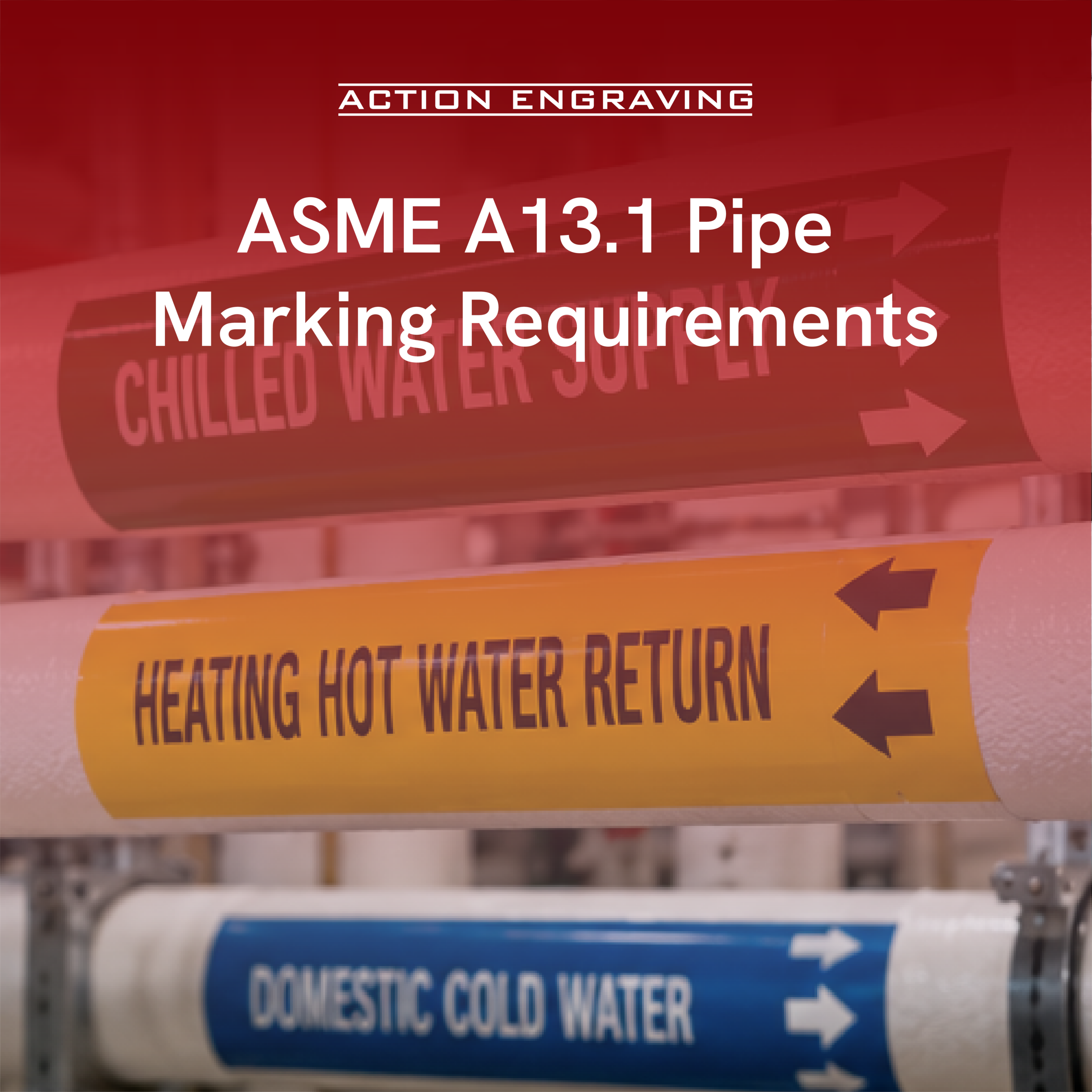
CHILLED WATER
COMPRESSED AIR
NATURAL GAS
STEAM
The wording should clearly identify the contents so someone encountering the piping can understand what the line carries.
- A Directional Arrow
The marker should also communicate the direction of flow.
For example:
CHILLED WATER →
or
← COMPRESSED AIR
For systems where flow can occur in either direction, the identification system can indicate bidirectional flow. This becomes particularly important in complex mechanical spaces where multiple piping systems may run parallel to one another.
- A Color Classification
ASME A13.1 uses contrasting background and text colors to help communicate the general characteristics of the pipe contents. The color doesn’t replace the written legend. The two work together.
How Large Should Pipe Marker Lettering Be?
A marker that technically identifies a pipe isn’t particularly useful if no one can read it.
ASME A13.1 addresses both the size of the color field and the minimum height of the legend lettering based on the outside diameter of the pipe or covering.
That last part matters.
For an insulated pipe, the measurement is based on the outside diameter including the covering or insulation, rather than simply the nominal pipe size.
The A13.1 sizing guidance is:
| OUTSIDE DIAMETER OF PIPE OR COVERING | MINIMUM LENGTH OF COLOR FIELD | MINIMUM LETTER HEIGHT |
| 0.7-1.3 in | 8in | 0.5in |
| 1.4-2.4 | 8in | 0.7in |
| 2.5-6.7 in | 12in | 1.3in |
| 6.8-10 in | 24in | 2.5in |
| Over 10in | 32in | 3.5in |
For piping too small to accommodate standard identification, an alternate method of permanently attached identification may be needed.
Where Should Pipe Markers Be Located?
Good pipe identification isn’t only about what the marker looks like. It also needs to be installed where someone can actually see it. Markers should be positioned so the legend is readily visible from the normal point of observation.
Identification is particularly important around areas where the piping system could otherwise become difficult to follow, including:
- Changes in direction
- Branches and connections
- Valves
- Wall and floor penetrations
- Accessible piping runs
- Long continuous runs of piping
Project specifications, facility standards and authorities having jurisdiction may establish additional placement or spacing requirements.
This is why contractors should always review the specifications for the individual project rather than assuming one marker layout will work for every facility.
Why Do Pipe Markers Include Flow Arrows?
Knowing what’s inside a pipe is only part of the information someone may need. They may also need to know where it’s going. Directional arrows communicate the normal direction of flow through the piping system. For piping capable of flow in both directions, bidirectional identification can be used.
Consider two pipes running next to each other:
CHILLED WATER SUPPLY →
← CHILLED WATER RETURN
The arrows immediately provide information that the pipe legend alone doesn’t communicate. For technicians, facility personnel and contractors working around a complex piping system, that additional context can make the system much easier to understand.
What About Abandoned Piping?
Pipes that have been abandoned in place can create another identification problem. A pipe that looks like an active line may no longer be connected to an operating system. ASME A13.1 addresses identification of abandoned piping so that it can be distinguished from active systems. The recommended identification uses a white background with black lettering and a black border. If abandoned piping still contains residual hazardous material or has been pressurized for corrosion protection, the identification should communicate that condition as well.
For facilities with older infrastructure, properly identifying abandoned piping can be just as important as identifying active systems.
ASME A13.1 vs. Valve Tags: What’s the Difference?
Pipe markers and valve tags serve related but different purposes.
A pipe marker answers: What’s in this pipe, and which way is it flowing?
A valve tag answers: Which valve is this?
For example, a pipe marker might read:
CHILLED WATER SUPPLY →
A nearby valve might carry an identification tag such as:
CHW-142
That valve number can then correspond with a valve schedule, drawing, asset-management system or other facility documentation. In a well-organized mechanical identification system, pipe markers and valve tags work together to make the system easier to understand and maintain.
Related Resource: Valve Tag Standards: Content, Materials & Identification
Where Is ASME A13.1 Used?
ASME A13.1 applies broadly to aboveground piping in industrial, commercial and institutional environments.
That can include piping found in:
- Commercial buildings
- Hospitals and healthcare facilities
- Manufacturing facilities
- Industrial plants
- Data centers
- Central utility plants
- Institutional facilities
- Mechanical rooms
- HVAC systems
- Plumbing systems
The exact identification requirements for a project may also be influenced by construction specifications, owner standards, applicable codes and the authority having jurisdiction. A13.1 should be viewed as part of the larger project-identification picture rather than a substitute for reviewing the project’s specifications.
Choosing the Right Material for Pipe Identification
Once the required wording, color and marker size have been determined, the physical environment matters too.
Before selecting a pipe-identification material, consider:
- Indoor or outdoor installation
- UV exposure
- Moisture
- Temperature
- Chemical exposure
- Pipe or insulation surface
- Cleaning procedures
- Expected service life
- Required adhesion
A marker installed in a conditioned mechanical room may face very different conditions than one installed outdoors or in an industrial processing environment. Durable vinyl decals can provide a flexible solution for many piping and equipment-identification applications because they can be produced with custom text, colors, symbols and directional information.
Related Product: Vinyl Decals & Stickers
Is ASME A13.1-2026 the Current Standard?
Yes.
ASME A13.1-2026, Scheme for the Identification of Piping Systems, is the current edition of the standard and supersedes ASME A13.1-2023. The 2026 edition establishes the current framework for identifying aboveground piping covered by the standard. However, that does not automatically mean every existing facility must replace all of its pipe markers whenever a new edition is published. Projects and facilities may be governed by specific construction documents, owner standards, adopted codes or other requirements. Existing identification systems may also need to be evaluated differently from identification being designed for a new project.
Always verify the edition and requirements referenced by the applicable project specifications and authority having jurisdiction.
Building a Clearer Identification System
Pipe identification is easy to overlook until someone needs to understand a system quickly. ASME A13.1 provides a common framework for communicating what’s inside a pipe, the characteristics of those contents and the direction they’re moving. For contractors and facility teams, the result is a piping system that’s easier to identify, navigate and maintain.
When you’re ready to produce the identification specified for your project, Action Engraving can help with custom vinyl decals, pipe identification, valve tags and additional mechanical identification products built around your project requirements.
Need custom pipe markers or mechanical identification for an upcoming project? Request a quote from Action Engraving.
This article provides a general overview of ASME A13.1-2026 and is intended for educational purposes. Always consult the current ASME standard, project specifications and applicable authority having jurisdiction when determining requirements for a specific installation.
Frequently Asked Questions About ASME A13.1
What does ASME A13.1 stand for?
ASME A13.1 is the American Society of Mechanical Engineers’ standard titled Scheme for the Identification of Piping Systems. It establishes a common approach for identifying fluids conveyed through aboveground piping and their characteristics.
What is the current edition of ASME A13.1?
The current edition is ASME A13.1-2026.
What changed in ASME A13.1-2026?
One of the important changes is the current color-classification scheme. Flammable, combustible and oxidizing fluids are grouped under black lettering on a yellow background, while steam, steam condensate, boiler feedwater and other hot water use black lettering on a gray background. Contractors working from older A13.1 charts should verify their identification scheme against the current edition and the project’s specifications.
Does ASME A13.1 require pipe markers to identify what’s inside the pipe?
The identification system uses a legend to identify the pipe contents along with color and flow-direction information. The color category by itself is not a substitute for identifying the contents.
What color should a chilled-water pipe marker be?
Under the current A13.1 scheme, potable, cooling and other cold or tepid water uses white lettering on a green background. The legend should identify the actual piping service, such as CHILLED WATER SUPPLY or CHILLED WATER RETURN.
What color should a steam pipe marker be?
The current scheme identifies steam, steam condensate, boiler feedwater and other hot water using black lettering on a gray background.
Does ASME A13.1 apply to electrical conduit?
No. Electrical conduit is specifically excluded from the scope of ASME A13.1.
Do pipe markers need arrows?
Flow direction is part of the piping identification system. Directional arrows help communicate the normal direction of flow, while piping capable of bidirectional flow can be identified accordingly.
Are pipe markers and valve tags the same thing?
No. Pipe markers identify the contents and flow of a piping system. Valve tags identify individual valves and are typically coordinated with valve schedules or facility documentation.


