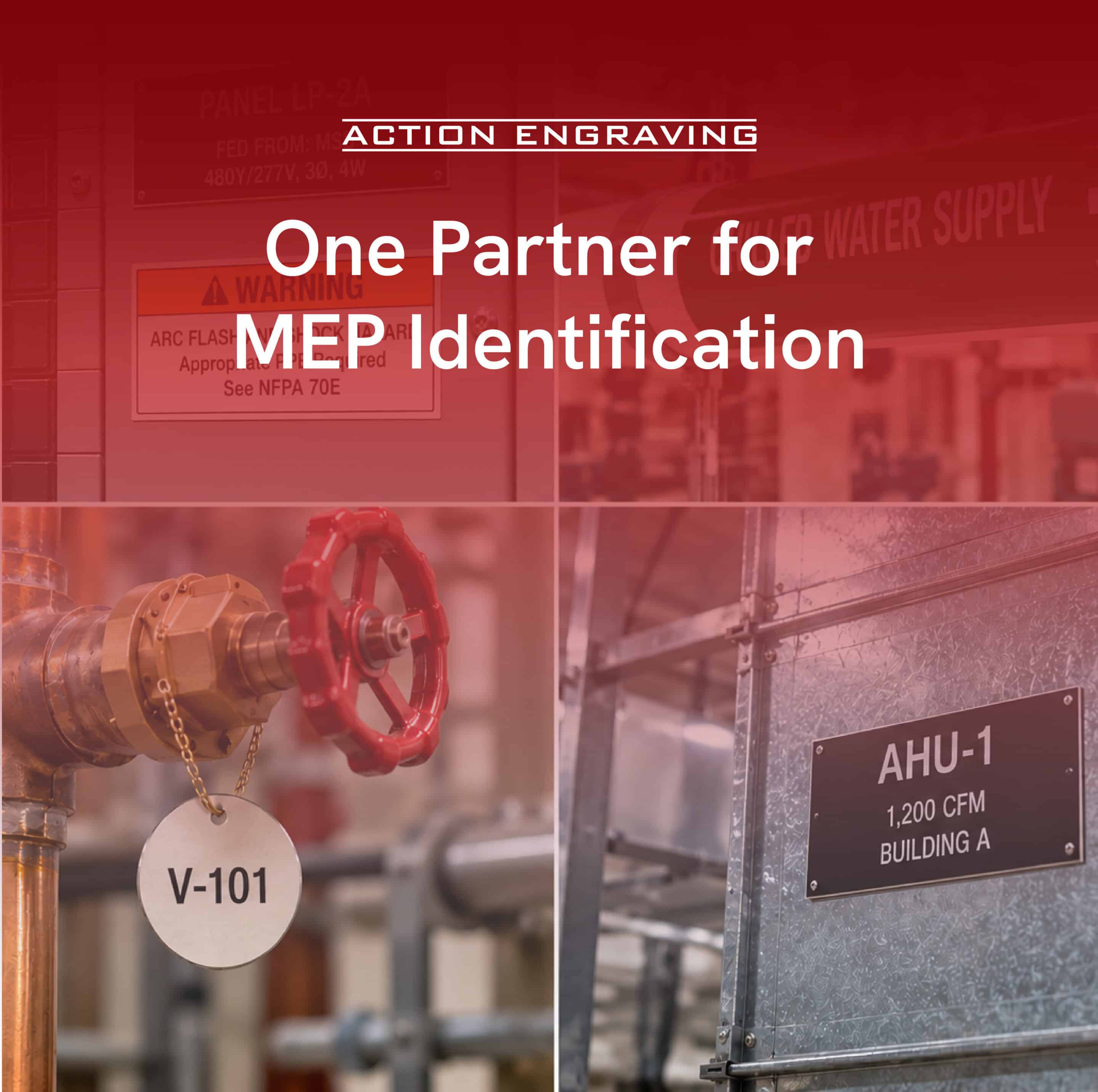
Identification is one of those things that shows up across nearly every part of a commercial construction project. Electrical panels, mechanical equipment, piping systems and valves all require different types of labels, tags or markers. While the products themselves may seem straightforward, the requirements aren’t always the same. Materials, wording, placement and applicable standards can vary depending on the system and application.
Whether you’re working on an electrical, mechanical, plumbing or HVAC project, understanding those differences can help you determine what identification you need and what to look for before ordering.
Different Trades. Different Identification Needs.
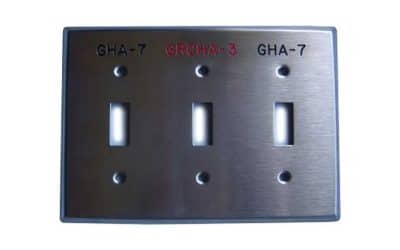
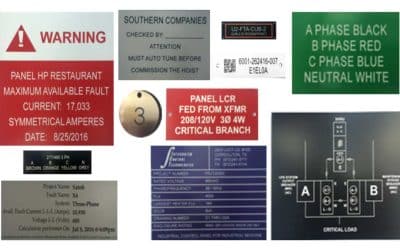
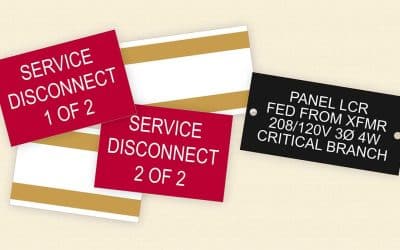
Most MEP identification falls into a few general categories, but the products and requirements can vary quite a bit depending on the application. Electrical identification includes everything from phenolic panel labels and engraved device covers to equipment nameplates, legend plates, metal tags and safety decals. Some labels identify equipment or circuits, while others communicate important safety information.
Mechanical and HVAC identification often involves pipe markers, valve tags and equipment labels. These systems can include extensive networks of pipes, valves and equipment, so keeping identification consistent with drawings and schedules is especially important. Plumbing identification has many of the same considerations. Pipe markers help identify the contents of a line, while valve tags and equipment labels make it easier to locate and reference individual components.
There can be a lot of overlap between these trades, but that doesn’t mean every label or tag serves the same purpose.
Pipe Markers: There’s More to Them Than a Name
At first glance, pipe identification seems pretty simple. Put a label on the pipe that tells someone what’s inside… But there’s more to consider.
Depending on the application, pipe markers may need specific colors, wording, directional arrows and placement to meet project requirements. Think about a mechanical room with chilled water, heating hot water, compressed air and other piping systems running throughout the space. Being able to identify those lines quickly matters to the people installing, maintaining and servicing them.
One of the most widely recognized standards for this is ASME A13.1, which establishes a system for identifying fluids conveyed through aboveground piping in industrial, commercial and institutional facilities. The standard was updated in 2026, making it worth reviewing if pipe identification is part of your scope. We’ve put together a more detailed guide covering the standard, including colors, wording, placement and directional flow.
READ: ASME A13.1-2026 PIPE MARKING REQUIREMENTS →
If you already know what your project requires and are looking for custom vinyl pipe identification, you can also explore the available product options.
EXPLORE PIPE LABELS & PIPE MARKERS →
Valve Tags: Small Tags, Important Information
A valve tag might only have a number or a few letters engraved on it, but that information can play an important role in identifying the valve. On larger mechanical and plumbing projects, valves are often assigned unique identifiers that correspond to a valve schedule. That schedule provides the additional information needed to locate, identify or understand the function of a particular valve. The tag connects the physical valve to that documentation.
Material selection is another consideration. Brass, stainless steel and phenolic are all commonly used for valve identification, but they aren’t necessarily interchangeable. Brass offers a traditional metal appearance. Stainless steel is another durable metal option. Phenolic provides flexibility for applications requiring different colors or custom sizes. The right choice depends on the environment, how the tag will be used and what the project specifications call for.
If you’re trying to determine which material makes sense or what information belongs on a valve tag, our guide breaks it down further.
READ: VALVE TAG STANDARDS — IDENTIFICATION, MATERIALS & APPLICATIONS →
Already have a valve schedule and know what you need?
Electrical Identification Has Its Own Considerations
Electrical identification can cover a lot of ground. Some labels are there to identify panels, circuits, equipment or devices. Others communicate safety information, such as electrical hazards or warnings. While a panel nameplate and an arc-flash warning label may be installed on the same piece of equipment, they serve very different purposes. That’s why it’s important to understand what information is required, where the identification will be installed and whether a particular code or project specification applies.
One area worth paying attention to is the 2026 National Electrical Code (NEC), which includes changes to arc-flash marking requirements for certain electrical equipment. We covered those changes in a separate article, including what electrical contractors should know about the updated requirements.
READ: 2026 NEC ARC-FLASH LABEL REQUIREMENTS & CHANGES →
A Few Things Worth Checking Before You Order
Whether you’re ordering 20 equipment labels or 2,000 valve tags, a little preparation can make the process much easier.
Before sending identification out for production, it’s worth checking:
- Project specifications: Are there required materials, colors, sizes or engraving methods?
- Wording and numbering: Does the identification match the latest drawings, schedules and equipment designations?
- Applicable standards: Are there specific identification requirements for the system or equipment?
- Installation environment: Will the labels be installed indoors, outdoors or in an area with environmental conditions?
- Quantities and organization: Are the identifiers grouped by room, panel, system or installation area?
- Changes and revisions: Are you working from the latest approved information?
None of these questions is particularly complicated, but overlooking one can create unnecessary rework. When a project has hundreds or thousands of individual identifiers, even a small mistake can turn into a much bigger headache.
Think Beyond the Individual Label
One thing that’s easy to overlook is how much identification can be involved within a single scope. A mechanical contractor might need pipe markers, valve tags and equipment labels. An electrical contractor could have panel labels, engraved device covers, warning decals and metal tags spread across multiple areas of a building. Each product might be relatively simple on its own, but coordinating all of them is another story.
Different materials. Different lists. Different installation locations. Different delivery dates.
Looking at identification as a complete package, rather than a collection of individual products, can make it easier to organize orders, coordinate deliveries and keep track of what’s still needed.
For contractors managing multiple MEP scopes, that approach becomes even more useful.
One Less Thing to Keep Track Of
At Action Engraving, electrical identification has been a big part of our business for years. But the same engraving and identification capabilities also support mechanical, plumbing and HVAC projects.
That means pipe markers, valve tags, equipment labels, engraved device covers, phenolic nameplates, metal tags and custom decals don’t necessarily need to come from separate vendors. We know how quickly those little things can hold up a much bigger project. That’s why we’ve built our process around fast quotes & production, two quality audits, organized packaging and free nationwide shipping.
Whether your scope involves one type of identification or several, the goal is the same: make sure the right labels and tags get where they need to go, without becoming another thing your team has to chase down.
Your scope. One identification partner.
MEP Knowledge Center
Identification isn’t just about making a label. The material, wording, placement and identification system can depend on the application, project specifications and applicable standards. Here are a few resources worth keeping on hand:
ASME A13.1: Identification of Piping Systems
ASME A13.1 establishes a common system for identifying fluids conveyed through aboveground piping in industrial, commercial and institutional environments. The 2026 edition is the current edition of the standard. Learn more about pipe marker colors, wording, placement, directional arrows and what’s changed in the latest edition.
Valve Tag Standards: Content, Materials & Identification
Valve tags help teams identify individual valves and connect them to valve schedules, system documentation and facility operations. Learn how valve tags are used and what to consider when choosing between brass, stainless steel and phenolic identification.
Read our guide to valve tags →
2026 NEC Arc-Flash Label Requirements
The 2026 NEC includes updates to arc-flash marking requirements for certain electrical equipment. See what’s changed and what electrical contractors should know about the new requirements.
Read: 2026 NEC Arc-Flash Label Requirements & Changes →
One Project. One Identification Partner.
Your project may involve electrical rooms, mechanical rooms, plumbing systems, HVAC equipment and miles of infrastructure. The identification doesn’t need to involve five different vendors. Send Action Engraving your schedules, specifications, spreadsheets or project files and let us help determine what we can handle.